

Critical, or just driven?
This post is about two papers: Neuronal Avalanches Across the Rat Somatosensory Barrel Cortex and the Effect of Single Whisker Stimulation, published in Frontiers in Systems Neuroscience in 2021, and Disentangling the critical signatures of neural activity, published in Scientific Reports in 2022.
The puzzle we have been following in the last posts is not only about dust particles. Whenever we measure the activity of two neurons, the expression of two genes, or two species moving together, we face the same ambiguity between a genuine connection and a shared hidden influence. Yet, we have only considered simple physical models so far. This time, we bring the question to a real system: the brain. In doing so, we will also discuss one of the most debated hypotheses in neuroscience: that the brain works the way it does because it sits at the edge of a phase transition.
The brain on the edge
A popular idea is that the cortex lives between two kinds of disastrous states. If neural activity were to die out faster than it spread between neurons, every signal would fade before getting anywhere. The brain would fall silent. On the other hand, if it spread too quickly, any activation by any neuron would be a spark that generates never-ending activity. This scenario would be very similar to what happens in seizures. Between the two regimes sits a special operating point, which physicists call critical: activity neither fades nor explodes, and fluctuations of every spatial and temporal scale can coexist. This resembles the behavior of a system at a phase transition, like water boiling into steam, or a magnet losing its magnetization, and it is closely related to the interactions between the system’s parts - water molecules, atoms, or neurons. The critical brain hypothesis proposes that biology has somehow tuned the brain to sit close to this point, where the argument is that it would be best equipped to represent a noisy, ever-changing world.
How would you check something like that? The classic fingerprint is the so-called neuronal avalanche. We have known for a long time now that, when the brain is not doing any specific task, the resulting spontaneous activity of the cortex comes in bursts. Some neurons fire, trigger others, and the resulting cascade may spread for a moment only or persist for longer before dying out. This looks surprisingly similar to how grains of sand topple in a sandpile, sometimes moving by small amounts, sometimes causing avalanches. Count how many events each cascade of activity contains, and criticality makes a sharp prediction: there should be no typical size. Most avalanches involve a handful of events, some are large, a few sweep through everything you can record, with frequencies falling along a power law. A power law is a mathematical distribution that shows up when the same statistics appear at every scale. Some twenty years ago, such power laws were first measured in cortical tissue for both the size and duration of neural activity, and they come with exponents describing how such activity changes across scales.
Our experimental collaborators in Padova ran experiments in rats, who read the world largely through their whiskers. Their brains are organized accordingly, with each whisker connected to its own dedicated column of cortex, a cylinder of tissue crossing all six cortical layers in a region called the barrel cortex. We recorded one such column in an anesthetized rat, layer by layer, and looked for avalanches in spontaneous activity, while nothing was touching the whiskers at all.
They are there. Avalanche sizes and durations follow power laws, and we found that the exponents of those power laws follow a strict relation predicted by the theory of critical systems known as the “crackling-noise relation”. Interestingly, we also looked at what happens to them when the whisker is stimulated by a controlled flick, and the picture changes: the column answers with a synchronized wave through all its layers, which shows up as an excess of very large avalanches on top of the power law. The critical-looking regime is how the column idles waiting for a stimulus, which briefly kicks it into a different mode.
So: power laws in a primary sensory area, exponents obeying the right relation. Case closed in favor of the critical brain?
Unobserved neurons as a hidden environment
If you have read the first post of this series, something should be nagging at you. “We see power-law avalanches, so the network is critical” has the same shape as “we see correlated activity, so the neurons are connected”. And we know how that second argument can fail. Not only that: a column of cortex is about as far from isolated as a physical system can be. Its neurons are just a small subset of the whole brain, so they receive constant inputs from everything we are not recording. And much of that input is shared and slow. A slow, shared influence acting on every unit at once looks exactly like a hidden environment.
So we did to the data what we have been doing to toy models all along: we built the simplest model we could think of, looked for avalanches, and then tried to understand what was causing them by removing pieces. The model has many neurons interacting with one another, and we can infer such interactions directly from the recordings themselves. On top of such interactions, a slow shared input drives the network of neurons and stands for everything else we were not recording. By running simulations of the model, we found avalanches exactly as in the data. But now, we could trace back their origin to the ingredient that they actually need.
Surprisingly, if we remove all interactions - so that neurons stop talking with each other - the power-law avalanches survive, with the right exponents and relations between them. Remove the shared slow drive, and they disappear. As it turns out, it is the shared drive that is producing the avalanches: a strong drive ignites activity across the whole neuronal population at once, while a weak drive makes the column go silent. As it slowly moves between these two extremes, it generates cascades of every size in between. In doing so, it makes every neuron carry information about the same thing, and that shared dependence, not any critical interaction, is what produces the avalanches.
So, are interactions irrelevant? Not at all. Avalanches are only one of the many signatures of criticality. Another important feature of critical systems is that the fluctuations of neural activity show scale-free correlations across the brain. Once more, these correlations lack a typical scale: they are long-range, stretching across the whole recorded area, and their reach grows with the size of the region you analyze. In a model without interactions, we find that the shared drive cannot fake those. Rather, they only appear when we plug in exactly the interactions between neurons we infer from the data. Furthermore, if we use the model to measure the mutual information between neurons, these two contributions - avalanches and correlations - are cleanly separated, with the interactions adding their share of information on top of the environment’s, exactly as they did in the spring world of the first post.
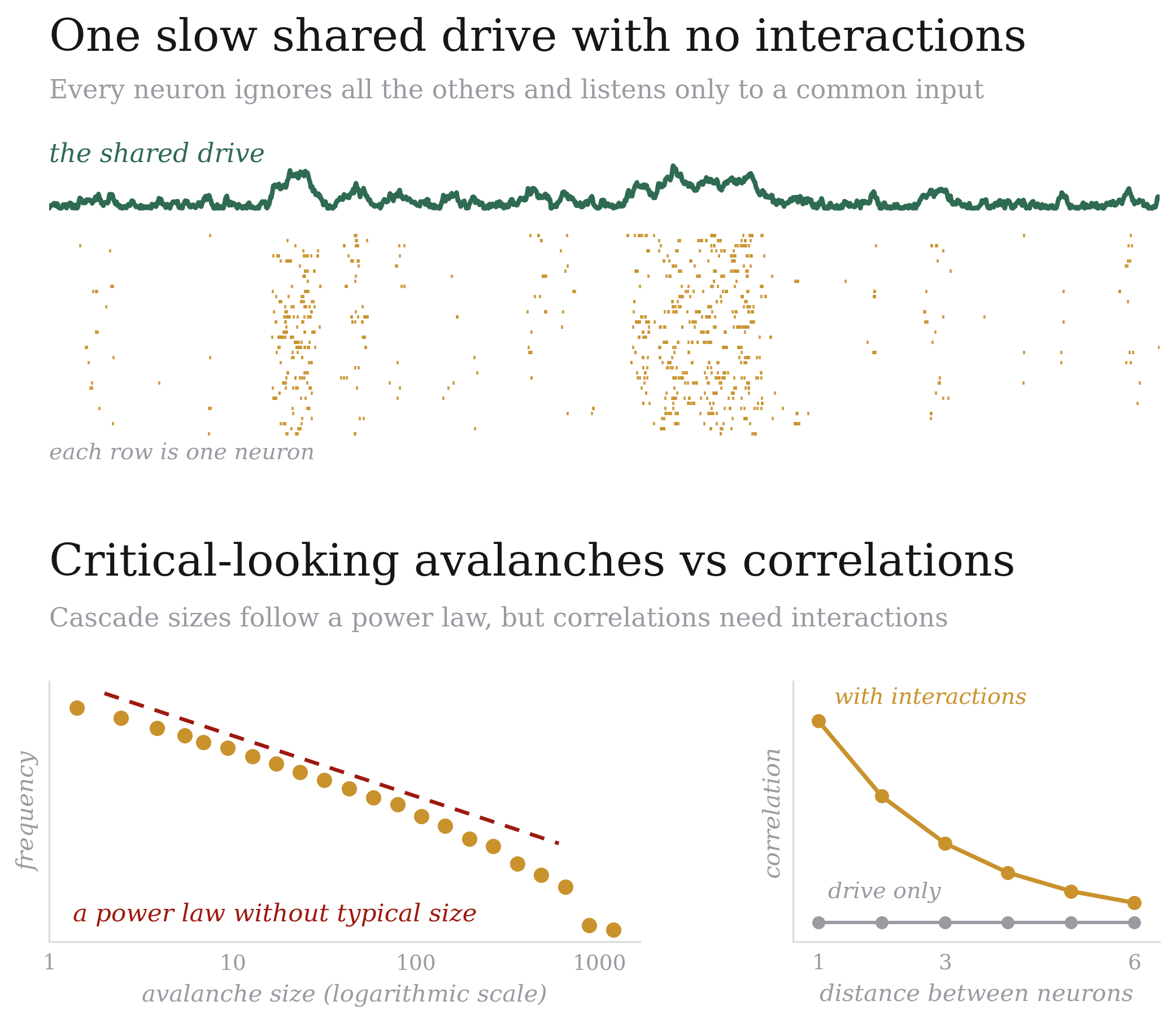
Why it matters. These results say something important about the critical brain hypothesis. The presence of power-law avalanches is not enough to conclude that the brain is critical, because a slow shared drive produces them without any critical interactions underneath. The cortex is not isolated, so it is rife with slow shared inputs. This teaches us that, if we want to test the hypothesis, the discriminating evidence lies elsewhere, such as in the long-range correlations of the fluctuations. Disentangling, in the end, is exactly this: working out which parts of the data speak about the system, and which parts speak about its surroundings. And, in doing so, we may learn something about the system itself and how the brain works.
So far, the environment has played the role of the villain throughout. It has faked connections that were not there, hidden real ones, and now forged fingerprints of criticality. For a living organism, though, those environmental signals are precisely what its brain is there to pick up. Next time, we will look at the problem from that side and ask what a system should do when the same signal arrives over and over again. Getting used to it, it turns out, is a smarter answer than it sounds.
Some technical details
The experiments and the avalanche analysis. Local field potentials and multi-unit activity were recorded across all six layers of a single barrel column of the somatosensory cortex of anesthetized rats - the LFPs with a 256-electrode CMOS array, spikes and MUA with a 32-channel linear probe - both at rest and after a controlled single-whisker deflection delivered through a piezoelectric bender. For avalanches, events are excursions of the signal beyond \(3\) standard deviations of the noise, and to compute discrete events, time is divided into bins of the order of the mean inter-event interval. Then, an avalanche is a maximal sequence of non-empty bins, with size \(S\) the number of events it contains and duration \(T\) its number of bins. The distributions \(P(S) \sim S^{-\tau}\) and \(P(T) \sim T^{-\tau_t}\) are fitted by maximum likelihood, with an undersampling procedure to control for the temporal correlations of the recordings. The exponents vary across animals and signal types, but the pairs \((\tau, \tau_t)\) fall along the scaling line defined by the crackling-noise relation
\[\langle S \rangle(T) \sim T^{\delta}, \qquad \delta = \frac{\tau_t - 1}{\tau - 1},\]with a seemingly universal \(\delta \approx 1.28\). After the whisker deflection, the size distribution develops a bump at large sizes - an excess of avalanches made of near-simultaneous events across layers - which is absent from the duration distribution, the signature of a transient cross-layer synchronization accompanied by post-stimulus oscillations around \(6\) Hz that are absent at rest.
The model. The recorded activity is modeled as a multivariate Ornstein–Uhlenbeck process,
\[\dot v_i(t) = -\sum_j A_{ij} v_j(t) + \sqrt{D(t)}\, \eta_i(t), \qquad A_{ij} = \frac{\delta_{ij}}{\gamma_i} - W_{ij},\]where \(W_{ij}\) are effective interactions and \(D(t)\) is a common modulation of the input to all units: an Ornstein–Uhlenbeck process with timescale \(\gamma_D \gg \gamma_i\), reflected at a floor \(D^*\). This is essentially the model of the first post but applied to the real world, where the switching diffusion coefficient has become a continuously drifting one, and the two particles have become the whole recorded array. As before, the shared modulation alone induces no linear cross-correlations, so that with \(W = 0\) the covariances \(\langle v_i v_j \rangle\) vanish for \(i \neq j\), and the dependence induced by \(D(t)\) is invisible to them. The covariance matrix measured in the data can therefore be attributed to the interactions, and inverted for \(W\) by solving the stationary Lyapunov equation.
Results. With \(W = 0\), in the regime where the modulation is slow and its floor low, the model generates power-law avalanche sizes and durations satisfying the crackling-noise relation with \(\delta \approx 1.28\), matching the data. Adding the inferred interactions leaves the avalanche exponents essentially unchanged. The spatial correlations behave in the opposite way: the correlation length \(\xi\) of the fluctuations, which is measured as the distance at which the correlation function of the fluctuations around the mean crosses zero, grows linearly with the linear size \(L\) of the analyzed window only in the presence of the interactions. Thus, it reproduces the scale-free correlations found in the recordings. The mutual information between units captures both contributions at once: it switches on at the onset of the avalanche regime, driven by the shared modulation, and the inferred interactions shift it by an amount that does not depend on the modulation parameters. Once more, this is the additive structure of the first two posts at work in a data-constrained model. Finally, the same phenomenology appears in a nonlinear setting: non-interacting Wilson–Cowan units of coupled excitatory and inhibitory populations, driven by the input of an unobserved balanced population, produce power-law avalanches satisfying the crackling-noise relation whenever the drive fluctuates strongly, suggesting that extrinsic generation of avalanches is a broad mechanism that extends beyond Gaussian models.
Front. Syst. Neurosci. 15:709677 (2021) · Sci. Rep. 12, 10770 (2022)